
A loved one starts forgetting appointments. Medications are missed. A small safety concern becomes a big one. And suddenly the question is, “What do we do?”
These are moments so many Maryland families know all too well. Caring for a family member with memory loss can be challenging. For the first time, caregivers will have digital access to an innovative, evidence-based digital tool designed to help families caring for someone with cognitive challenges identify needs, access information, and connect with local resources.
This self-service tool was developed by three partners who came together with a shared goal of making it easier for families to move from worry to action.
“Caregivers are often looking for multiple answers that require coordination across a lot of different platforms. This tool is a great start, and puts it all together based on individual needs,” explained Vinicia McNeil Joyner, a MEMORI Corp member.

From research to resources: how this collaboration delivers
Memory loss impacts health care, aging services, transportation, housing, caregiver burnout, home safety, and so much more. No single organization can solve that alone.
This project is a perfect example of how Maryland moves faster and smarter when partners align.
- The Johns Hopkins School of Nursing brings the research foundation and clinical insights. The digital Checklist was adapted from the Johns Hopkins Dementia Care Needs Assessment.
- The Maryland Department of Aging provides statewide leadership and innovative approaches to aging and equitable resource allocation, connecting older adults through Maryland Access Point (MAP).
- Maryland Information Network brings the connective infrastructure that turns recommendations into real-world pathways to help.
Together, we shared ideas and insights that led to this innovative new product. It showcases what we do best: build shared infrastructure that makes it easier for Marylanders to find help!
Maryland Information Network powers the tool’s technology and referral information.
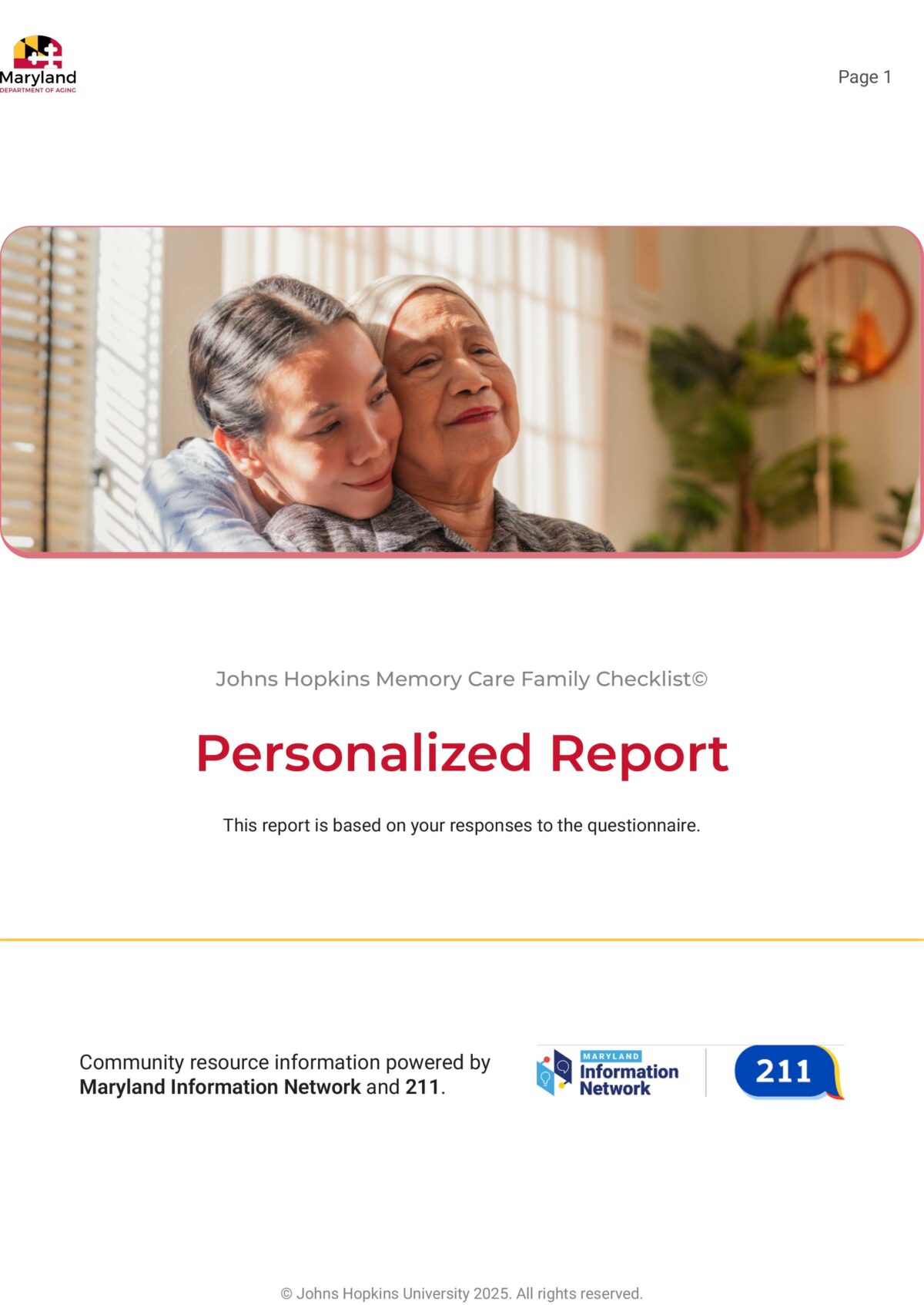
After completing the 70-question checklist, every user will get a Personalized Report that identifies their needs and explains what they need to know, what they need to do, and where they can go for help.
The Checklist creates a clear path that’s more personal and connected. Marylanders are linked directly to the Maryland Access Point Help Line and Resource website, powered by the 211 Community Resource Database and Call Center.
A personalized roadmap for memory care
The Memory Care Family Checklist guides caregivers through practical questions that take about 15 minutes to answer.
For the person living with memory loss:
- Daily routines and meaningful activities
- Cognitive, emotional, and behavioral changes
- Personal and home safety
- Health care and future planning
For the caregiver:
- Health and well-being
- Education and awareness
- Informal support networks
- Daily living needs and planning
At the end, the tool generates a personalized report that highlights what to focus on next, along with recommended supports and information based on the caregiver’s answers.
“I had no clue what to do first. The Checklist pointed out several important issues I needed to address that weren’t even on my radar. It included links to programs in my community to help me manage my situation that I never would have without it. It’s a wonderful resource that I highly recommend!” a caregiver wrote.
It does not replace a clinician. It does not diagnose. It does what families often need most: it connects them to trusted information and resources.
The difference-maker: connecting guidance to local help
A great assessment tool can tell you what you need. MdInfoNet helps make sure you can actually find it.
Through MdInfoNet’s statewide infrastructure and partnership approach, the Checklist connects families to trusted pathways like Maryland Access Point (MAP), and to local, up-to-date community supports through 211’s Community Resource Database, which powers MAP.
In addition to connecting families to resources on the MAP website, the MAP Help Line is available to help connect Marylanders. The Help Line is administered by Life Crisis Center, which is part of the 211 Call Center Network.
The Checklist is built to help families take the next step with confidence, and with options that reflect where they live and what they need.
“We must ensure our caregivers and their loved ones have every tool available to them, and this Checklist is one more critical resource we are proud to offer Marylanders,” said Gov. Wes Moore.
”The collaboration between the Maryland Department of Aging, Johns Hopkins University, and the Maryland Information Network is a prime example of how Maryland-based innovation is not just about advancing technology. It’s about improving lives and making an impact. Through LRM and partnerships like these, we are working to build a care infrastructure that leaves no one to face caregiving challenges alone.”
Built on decades of research, designed for real life
Over 15 years ago, a team of researchers at the Department of Psychiatry and Behavioral Sciences at the Johns Hopkins University School of Medicine developed the Maximizing Independence (MIND) at Home Program.
MIND at Home uses the Johns Hopkins Dementia Care Needs Assessment (JHDCNA) to identify needs.
The Checklist was adapted from the JHDCNA, an evidence-based approach that captures modifiable dementia-related care needs for the person living with dementia and their caregiver.
“Caring for a loved one with memory loss can be a tough job. It impacts so many areas of life and family caregivers often find themselves having to provide not only day-to-day care, but also making complicated care decisions with little information while navigating unfamiliar care systems,” said Dr. Quincy Samus, Professor at the Johns Hopkins School of Nursing.
“The Checklist translates decades of clinical know-how and science research into a free, private, and personalized tool that empowers caregivers with action-oriented information on how to support their loved ones while caring for themselves, and ways to find and connect with local resources.”
The Virginia I. Jones Alzheimer’s Disease & Related Dementias Council and the Maryland Commission on Caregiving endorse the Johns Hopkins Memory Care Checklist.
What’s next
This is just the beginning of developing personalized tools for help. MdInfoNet’s data shows that people prefer digital tools, with 4x as many Marylanders accessing help digitally over traditional services.
The Checklist is a model for how Maryland can strengthen and scale connections to help. We’re interested in developing additional digital assessments to serve other populations, both clinically-validated and focused on social determinants of health.
We’ll also be working with our partners to monitor and identify needs among caregivers and people living with memory loss who complete the Checklist. This valuable data will help inform next steps for the state.
When trusted research, trusted resources, and trusted agencies work together, we can scale solutions faster that strengthen Maryland’s connections.
Development of the Checklist was funded by the Administration for Community Living (ACL), U.S. Department of Health and Human Services (HHS).
This information is that of the authors and does not represent the official views of, nor an endorsement by, ACL/HHS or the U.S. Government.
Insights are provided to support early care planning. They are not a replacement for clinical diagnostic evaluations, treatment plans, or a prescription for any disease or health condition.
MdInfoNet is a public-benefit 501(c)(3) nonprofit and state-designated administrator of the 211 system in Maryland. <br> Kenyn Benjamin is the president and CEO, building a more connected health and human services ecosystem using leading technology and comprehensive information to inform, connect, and drive data-driven decisions across the state that better connect agencies, systems, and people.
A mother sat on a hospital call, her voice breaking.
I am not a mother who doesn’t care about her child. But she needs help, and I don’t know what else to do.
This is what system strain sounds like. Her daughter, a minor child, had been stuck in an emergency department for days because no placement could be found. Each hour she remained there, her chances of psychiatric decomposition increased. She needed a safe, structured environment equipped to support her needs beyond the immediate crisis. The emergency department was never built for that purpose.
Helping Children in Crisis
I lead Maryland Information Network, the state-authorized administrator of the 211 system in Maryland, where every day we hear from parents desperate to find care for their children in crisis, and from emergency department staff carrying the weight of patients with no clear next step.
Every day, we see these moments unfold in real-time across the ecosystem. In this case, it’s pediatric overstays, but we also see it with food, housing, child care, and other essential needs. At Maryland Information Network, we’re building infrastructure so we can quickly deploy solutions that relieve worry for parents, administrative burdens for hospitals, and provide state leaders with the data they need to take the next step.
Coordinating health and human services
Here’s the complex reality. Families are in crisis. Hospital teams are doing everything possible within the limits of fragmented systems.
State leaders are investing significant resources to address pediatric overstay and psychiatric ED boarding. While these investments are creating pathways for structural change and innovative solutions, we need to coordinate our efforts to make it easier to navigate Maryland’s health and human services system.
At Maryland Information Network, we saw an opportunity with this policy direction to build infrastructure that aligns with these investments. We’re bringing partners together from hospitals, local behavioral health organizations, and even the school system to bridge the gaps and reduce ED overstays and hospital readmissions. We developed 211 ConnectCare, a patient referral system that seamlessly integrates hospital care with community-based resources.
This platform enables hospital discharge teams to submit referrals quickly and securely, ensuring the right information reaches the right partners to act fast. It gives care teams confidence that they are not alone in the placement process. Just as importantly, it creates a centralized record of placement needs and referral trends.

For the first time, Maryland has a coordinated digital front door that not only connects hospitals, community providers, and state agencies to resolve ED boarding patient by patient, but also gives policymakers a statewide view of where the system is working, where it is breaking down, and how to strengthen it.
Hospitals across the state are already using ConnectCare to better coordinate placements for psychiatric patients at risk of extended ED boarding and pediatric patients facing hospital overstay.
This is more than a referral tool. It is transforming how Maryland responds to ED boarding, bridging day-to-day coordination with the data insights needed for long-term solutions.

This is the power of policy translated into action.

The power of turning the right investments into impact.

The power of coordinated care in upholding human dignity.
When we build coordinated infrastructure, we enable patients to move into care with dignity and speed. We give families confidence that their loved ones will not remain in limbo. We strengthen hospitals by restoring their capacity to provide emergency care.
To our state policymakers, agency leaders, and community partners, I say this:
Because of your investments and leadership, solutions like 211 ConnectCare are possible. Maryland Information Network remains committed to bridging data gaps to deliver insights and empower decisions that create real relief for hospitals and real dignity for patients and families.
Maryland Information Network (MdInfoNet)
MdInfoNet is a public-benefit 501(c)(3) nonprofit and state-designated administrator of the 211 system in Maryland. <br> Kenyn Benjamin is the president and CEO, building a more connected health and human services ecosystem using leading technology and comprehensive information to inform, connect, and drive data-driven decisions across the state that better connect agencies, systems, and people.